
Abstract:
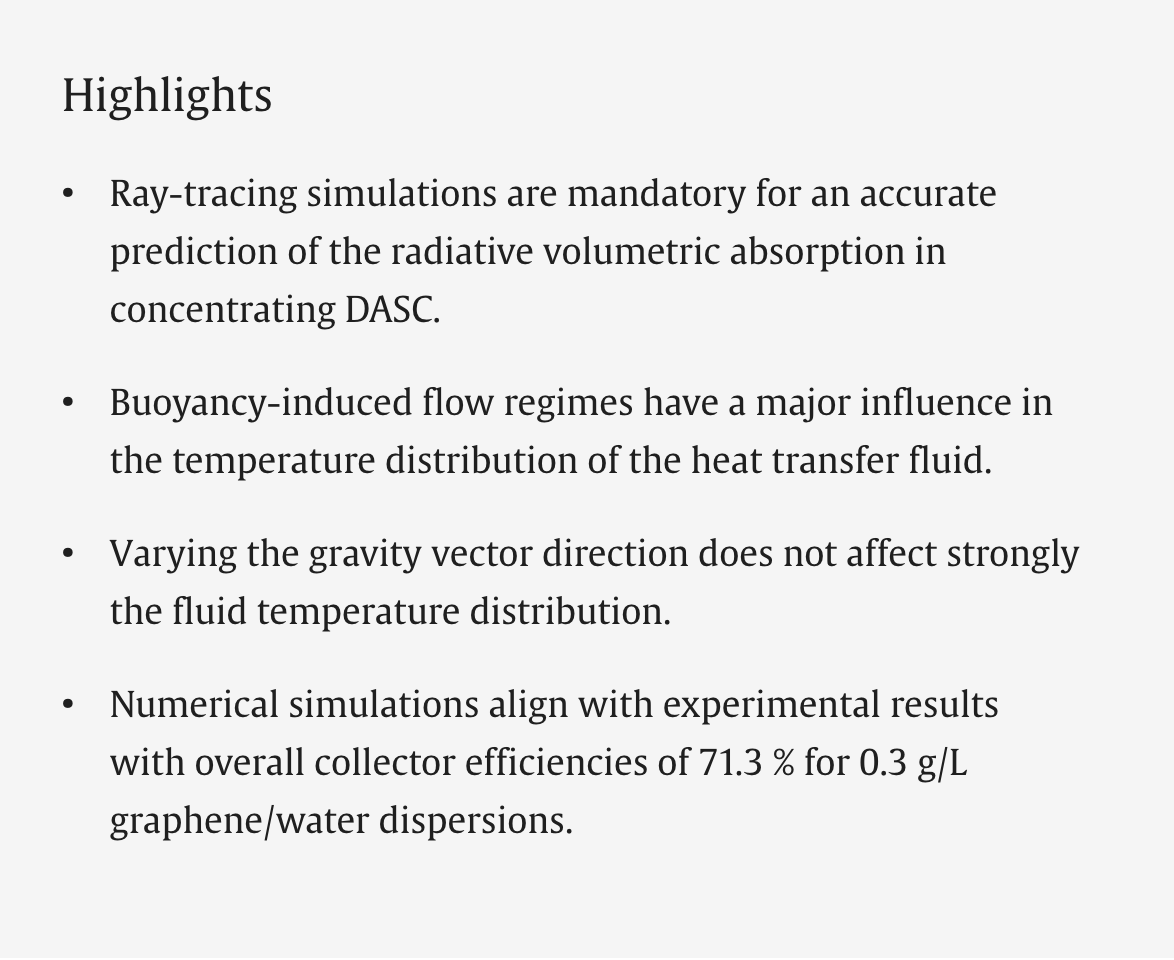
Direct absorption solar collectors have gained attention in the last decades as a promising solution to enhance the performance of conventional thermal collectors. In this concept, the heat transfer fluid absorbs the concentrated radiation volumetrically, which optical properties can be enhanced by dispersing nanoparticles. While several works have reported the benefits of volumetrically absorbing the incident radiation, few studies have explored its effect on the fluid temperature distribution. The presents paper offers a comprehensive numerical analysis of the optical and thermal behavior of a parabolic-trough direct absorption solar collector using a graphene nanoparticle dispersion as absorbing medium. A Monte Carlo based ray-tracing approach is coupled to a computational fluid dynamics analysis to offer a complete evaluation of the performance of such systems. The results reveal a trade-off between complete absorption inside the tube and strong absorption in the wall vicinity, which takes place at higher optical depths. Furthermore, the fluid dynamics simulations underscore the role of buoyancy forces in achieving homogeneous temperature distributions, especially at lower flow rates. Neglecting gravitational effects may lead to inaccurate predictions of the system thermal performance. The numerical predictions align closely with experimental campaigns conducted for a similar collector, with total collector efficiencies of 66.3 % and 71.3 % for 0.2 g/L and 0.3 g/L nanofluids respectively. While these results represent a first-order comparison, they suggest that the model is reliable for designing and optimizing PT-DASC systems for real-world applications.
Miguel Sainz-Mañas, Françoise Bataille, Cyril Caliot, Gilles Flamant,
Modelling of flow regimes in tubular concentrating direct absorption solar collectors, Applied Thermal Engineering, Volume 279, Part C, 2025,127716, ISSN 1359-4311, https://doi.org/10.1016/j.applthermaleng.2025.127716