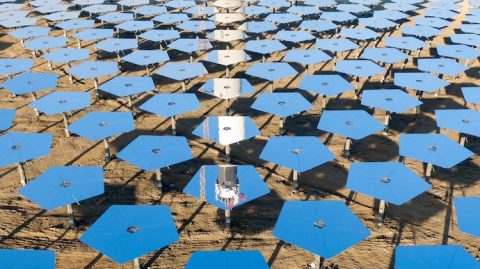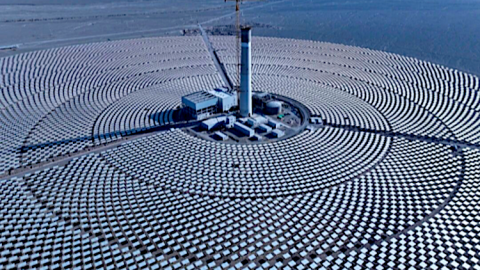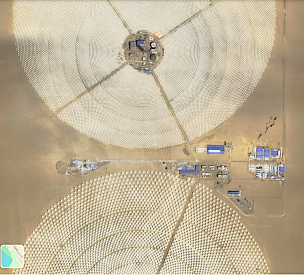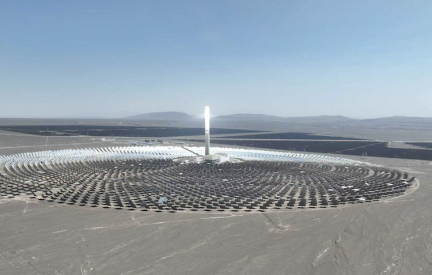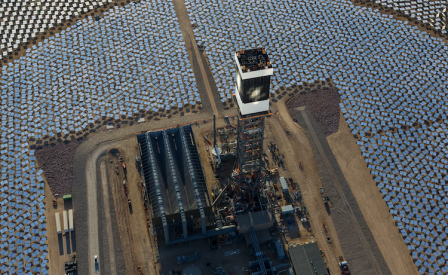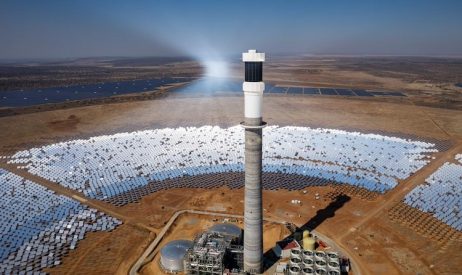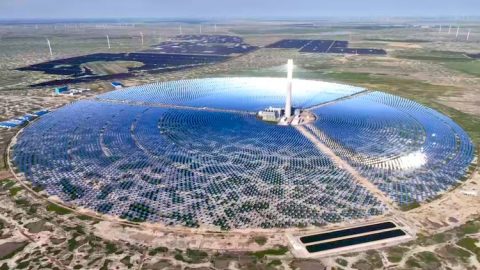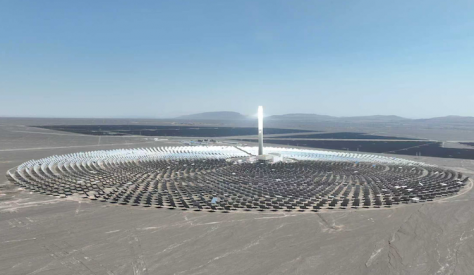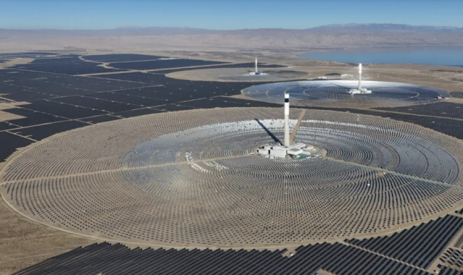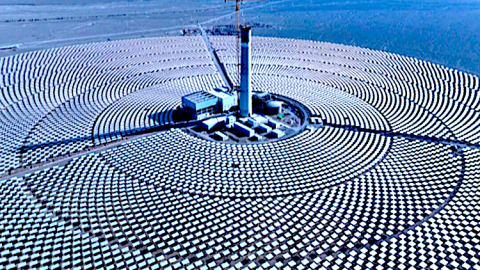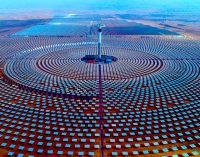


Two California electric utilities have moved to exit long-term contracts to buy power from Ivanpah, a unique first-of-its-kind utility-scale solar tower project that has delivered only around 70–80% of its projected annual generation since it began operating in 2014.
The partners, which included Google, Pacific Gas & Electric, and Southern California Edison, have cited underperformance and high costs in seeking to end the contracts they signed in 2013 for two of the 392 MW Ivanpah concentrated solar power (CSP) plant’s three units, years before the original 2039 end date.
The California Public Utilities Commission (CPUC) has rejected PG&E’s proposed termination agreements, at least for now, citing the need to keep existing clean generation online, rising electricity demand, and that the loss of hundreds of millions of dollars invested in associated transmission alone outweighs the losses the utilities claim.
The CPUC is also concerned that recent shifts in federal policy have created a more hostile permitting environment for all new renewables, with tax credit uncertainty, new tariffs on imported equipment, and tighter land-use rules for large-scale solar and wind projects all making any new project more uncertain, while the regulator is keeping to its requirement that California be 60% renewable by 2030, now a mere four years away.
Together, these factors increase the value of finding a way to make existing renewables like Ivanpah work economically, rather than walking away.
A solution for both sides
In a new Nature Briefing, four current and former senior solar researchers at National Laboratory of the Rockies (formerly NREL) discuss Ivanpah as an atypical example from the early days of CSP tower designs in California’s evolving power market.
Unlike every CSP project built subsequently domestically and overseas, Ivanpah was built with no thermal storage, limiting its ability to adapt to shifting grid conditions. The paper notes:
“Without storage, Ivanpah became an expensive source of electricity during the lowest-cost (or in some cases, negative-cost) time of day in California,”
Their core point is that Ivanpah failed because it lacked storage in a market that rapidly shifted toward valuing flexible, dispatchable capacity rather than inflexible midday energy.
They modelled a retrofit of Ivanpah that uses molten salt instead of direct steam, with 12 hours of thermal storage, and showed that such a dispatchable plant would be far more profitable under today’s market conditions.
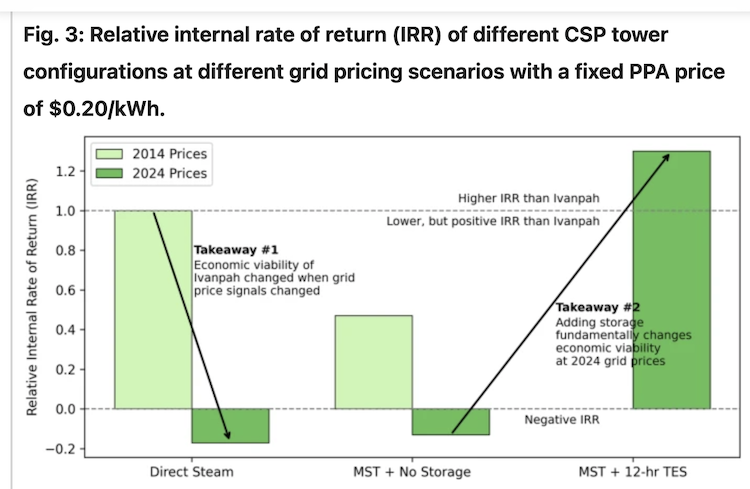
The authors modelled the economics of added storage, concluding “a molten-salt tower system located at Ivanpah with 12 hours of storage has an IRR 30% higher at today’s grid prices than Ivanpah did at 2014 grid prices (with the same PPA).”
This would dramatically change the economics for the partners, which include both offtaking utilities and Google.
Ivanpah’s near-perfect solar field performance
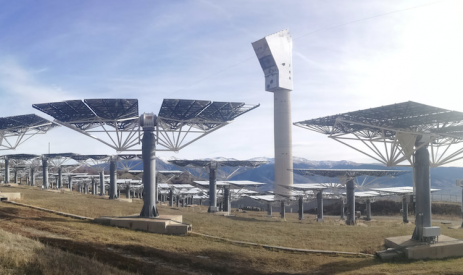
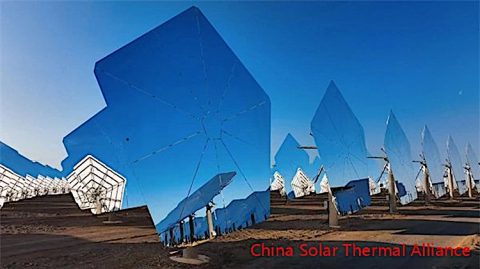
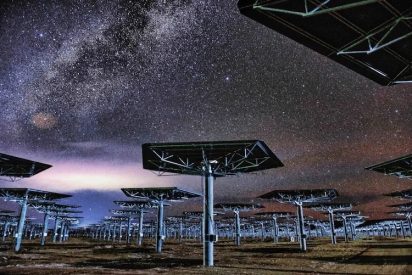
It is not as if the entire project was a failure. The solar collection system, comprising the heliostat field control system, the tracking algorithms, mirror positioning precision, and field layout optimization, was a near-perfect technical success.
The Nature article notes:
“Despite Ivanpah’s headline challenges, the large heliostat field proved itself to meet the design-point needs of the power cycle, a significant technical achievement for the industry and proof of the scalability of heliostat technology. Tens of thousands of heliostats have been individually controlled autonomously for many years at Ivanpah. The solar field achieved 92–94% availability, allowing the turbine to operate at design most days.”
So the solar field of heliostats performed nearly perfectly. The problem was how the heat was generated and used.
So why did Ivanpah deliver less than its projected energy?
“The choice to use direct steam is the root of many of Ivanpah’s challenges, most notably because direct steam systems cannot provide meaningful energy storage capacity. Therefore, Ivanpah’s production profile was directly related to the solar radiation; passing afternoon clouds could cause the power cycle to shut down until solar conditions improved. Natural gas is burned at start-up and during standby operations due to the lack of a thermal reservoir,”
the briefing noted.
This led to frequent cycling of the thermal power cycle, causing operational challenges.
And as a no‑storage, direct‑steam tower plant trying to compete in a market that quickly became saturated with low-cost solar output during midday and began to reward electricity production after sunset, Ivanpah was selling into the cheapest – and sometimes negative‑priced – hours of the day, while carrying high fixed capital costs, during the years when increased deployment of the much simpler solar panels enabled PV prices to drop.
How profitable might a molten salt-based Ivanpah be?
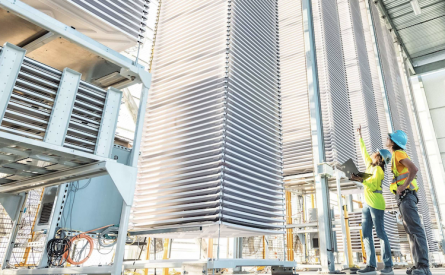
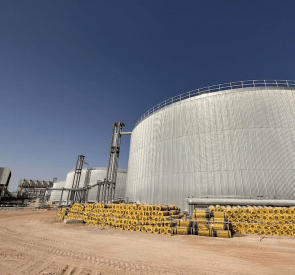
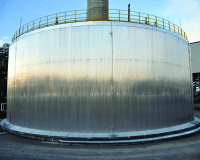
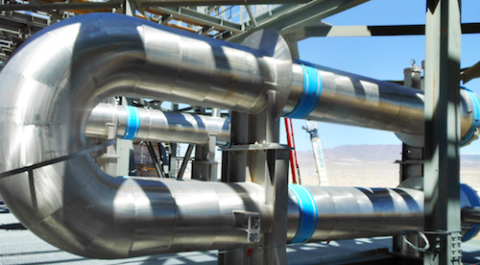
In their Nature Briefing, the solar experts examine that to meet the CPUC requirement that Ivanpah not be decommissioned, while also meeting the partners need for a profitable asset, Ivanpah should keep its high performance solar field of heliostats, but be retrofit with now proven thermal energy storage, replacing the steam based receiver in the tower with a molten salts receiver, and connect it to a molten salts thermal storage system.
The paper states: “A notional retrofit molten salt tower with 12-hour TES could have a PPA price as low as 6.99 cents/kWh at 2024 time-of-delivery schedules, assuming negligible tower and heliostat costs.”
Where is the molten salt expertize now?
Globally, the CSP industry absorbed the early lessons and moved on. Virtually all new commercial CSP plants built in the decade since included molten-salt thermal storage as standard, (even the NOOR I Plant in Morocco which deploys the BrightSource solar tower heliostat control system, and both Brightsource projects in Israel).
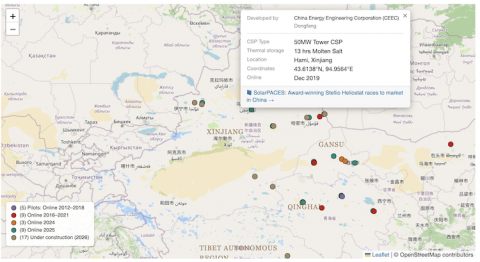
All the Chinese renewable parks explicitly required CSP with thermal energy storage.
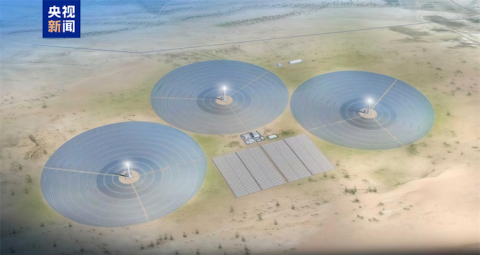
Now, several large Chinese state‑owned power firms like Power China and China Three Gorges Renewables (that built the 22 GW hydropower dam) have experience building and operating standardized 100-MW tower CSP plants with molten‑salt storage.
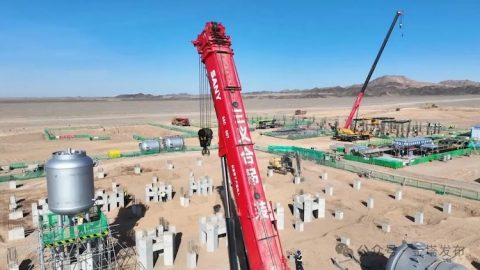
And a subsidiary of China’s National Nuclear Corporation, CNNC HuiNeng is building a massive (2 GWht) standalone molten salt-based thermal energy storage project to store electricity from a wind and solar park in Gansu Province.
If Google and its partners were to retrofit Ivanpah with storage to meet the CPUC’s demand to keep it online, they might look to China, which now has years of commercial operating experience with molten‑salt storage for tower CSP. China might bring exactly the kind of expertise a storage retrofit would take.
Perhaps Google could give Three Gorges a call