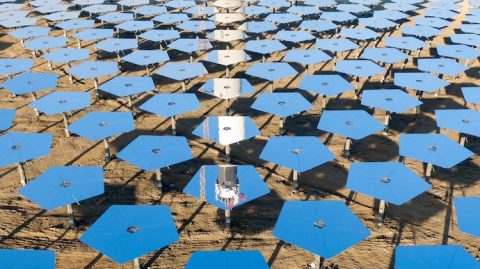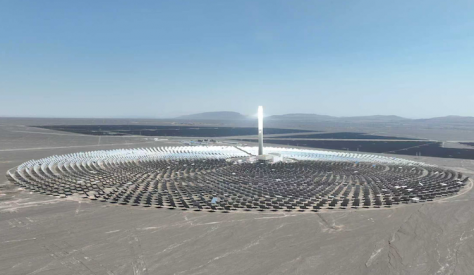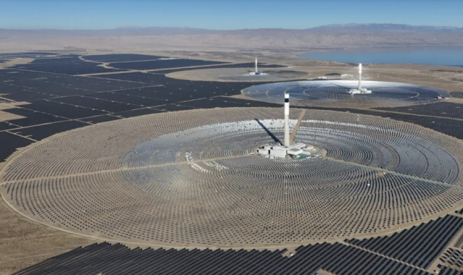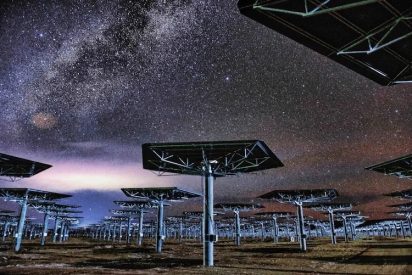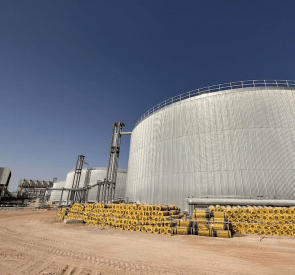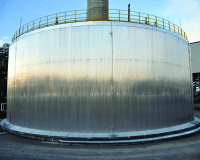

Replacing the standard two‑tank molten salt system with a single tank using a thermocline could cut capital costs and halve thermal tank losses in concentrated solar power (CSP) plants. But how big can a single tank safely be built when hot and cold molten salts share the same steel wall?
Freerk Klasing and his team at the German Aerospace Center (DLR) set out to find the answer. They looked at the structural limits for single‑tank molten salt storage diameters due to additional tank wall stresses caused by a thermocline at typical today’s CSP temperature range (approximately 290°C to 560°C)
Their paper Critical diameter for a single-tank molten salt storage – Parametric study on structural tank design was published at the Journal of Energy Storage
They found that, aside from the possible effect of thermal ratcheting (in some research, pebbles are included in the fluid to hold more heat, and when these pebbles settle they restrain the tank wall from contracting freely) there is actually a second critical phenomenon: wall bending.
Looking exclusively at wall bending, the team finds a practical upper bound diameter closer to 20 metres than the 35 metres of today’s two-tank systems.
The problem: one wall, two temperatures
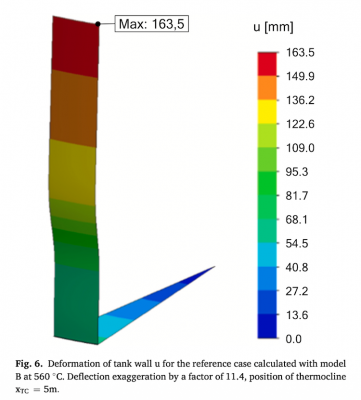
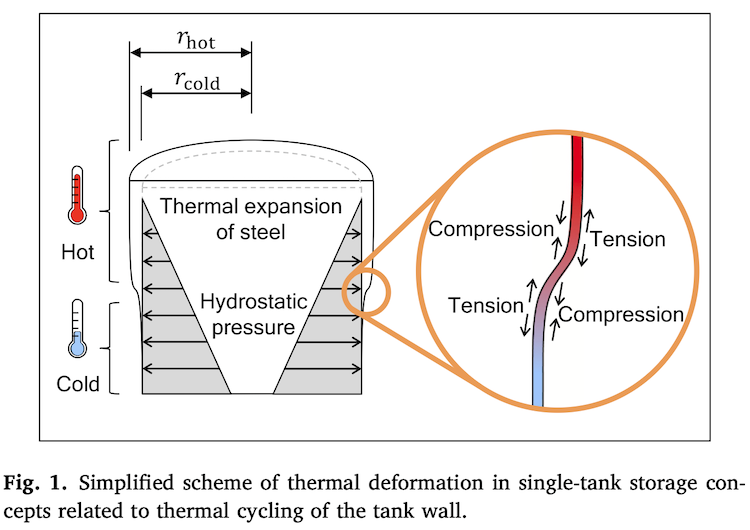
Current molten‑salt CSP plants store heat in two tanks, one hot and one cold. A single thermocline tank would instead keep the cold liquid at the bottom, hot liquid on top, and a temperature gradient develops in between (known as the thermocline). In that one tank, the steel wall near the hot top wants to expand more than the wall near the colder bottom.
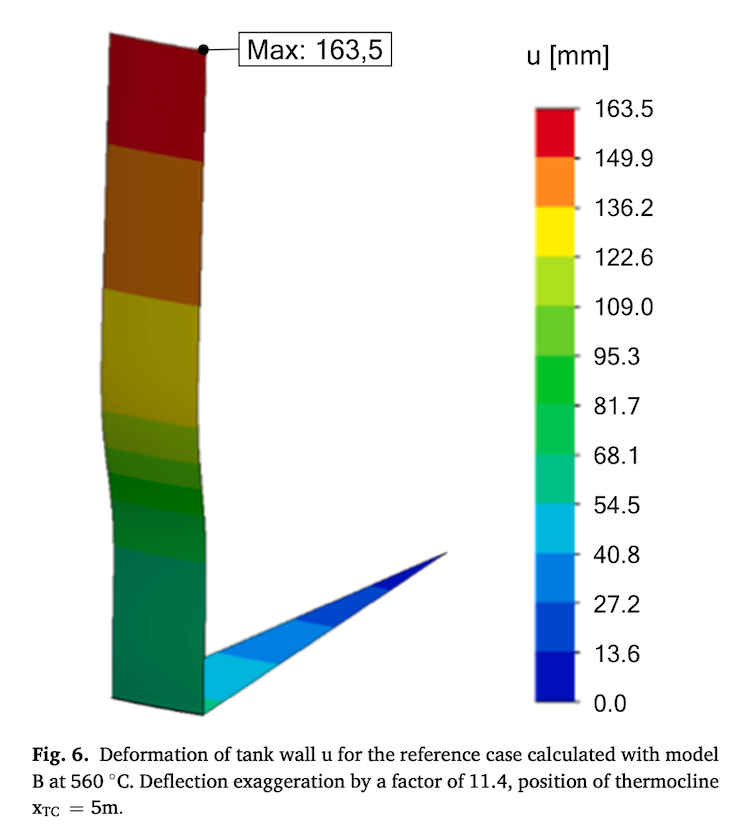
For large diameters, that difference in radial expansion can reach several centimetres, which bends the wall around the thermocline zone. Earlier work on thermocline storage focused mostly on thermal ratcheting when you use stones or other solid filler, or on familiar hot‑tank issues in two‑tank systems such as edge cooling, floor and foundation problems, and weld quality. Klasing’s study is the first to look specifically at these thermally induced bending stresses in large, high‑temperature single tanks with molten salt.
“You can find quite a lot of work on thermocline storage, but nobody had really asked how big you can make a single tank before the wall bending becomes a problem,” he said.
From entire tank to simple model
Rather than simulate a full tank every time, Klasing built a simplified structural model of a cylindrical tank wall under hydrostatic pressure plus a vertical temperature profile. The temperature over the wall height is described analytically, using the hot and cold temperatures, the position of the thermocline and its thickness as inputs.
He reduces a three‑dimensional tank to a one‑dimensional shell model that still captures bending and membrane stresses in the wall, and then validates this model against two experimental projects.
One is a thermocline filler tank from the Solar One project, and the other is a cryogenic liquid‑nitrogen tank that also saw strong stratification‑induced wall stresses. Once the simplified model matched the experimental data, he used it for a parametric sweep of sizes and operating conditions.
The reference case is a CSP storage system of about 1000 MWh, (typically tower CSP is 100 MW, with 10 hours of storage). The tank heights are limited by current pump shaft lengths to roughly 14 metres. They examined two operating ranges: today’s 290–560 °C tower storage, and an advanced 290–620 °C case that would lift power‑cycle efficiency and storage density.
For each case, the model varies tank diameter and thermocline thickness and calculates the wall thickness needed to keep membrane stresses below the allowable limits set by yield or creep strength over 200,000 hours.
Why a sharper thermocline limits tank size
One key result is that the sharper you try to make the thermocline, the smaller the maximum feasible tank diameter becomes.
A very thin thermocline zone increases the temperature gradient in the wall and so increases bending stresses. Designers like a compact thermocline because it reduces the amount of molten salts at unusable intermediate temperature, but the paper shows this has a structural cost once tanks grow beyond a certain size.
Another clear trend is that raising the hot‑salt temperature from 560 °C to 620 °C strongly reduces the permitted tank diameter – assuming you use the same steel. Higher temperature means more thermal expansion and higher stresses while material strengths decrease. So either the diameter must come down, or you need more heat‑resistant steels, or a different wall concept.
“In practice, this means you cannot just take a 35‑metre hot tank from a two‑tank system and assume you can replace both tanks with one thermocline tank of the same size,” Klasing explained. “The bending from the temperature profile with a span of around 300 Kelvin becomes too large. For realistic thermocline thickness and current steel grades, diameters closer to 20 metres are more reasonable.”
Optimising single‑tank design
Klasing does not suggest that it would be too difficult to switch to single-tank thermal energy storage.
“There is a lot of potential in single‑tank storage,” he said. “The point of this work is to identify possible limitations coming from thermal deformations, and to give designers a tool so they do not step over them.”
He added: “This aspect is equally important as thermal ratcheting and should be looked at right at the beginning of designing a single-tank system.”
Instead, the study offers a way to pre-design a single tank for thermal energy storage properly. Below a critical diameter set by temperature and thermocline thickness, the team finds single‑tank systems can be built with only a moderate increase in wall thickness compared to two‑tank systems while staying within stress limits.
The study ends with several design levers for future single‑tank thermocline systems. Operators could choose to manage thermocline thickness through charging and discharging strategy and by periodically extracting part of the thermocline zone. Plant designers could choose more heat‑resistant steels when they want to push to 620 °C, adjust tank height‑to‑diameter ratios, and if needed explore internal insulation that decouples the wall from the stratified salt or switch to a modular tank design.