
Abstract:
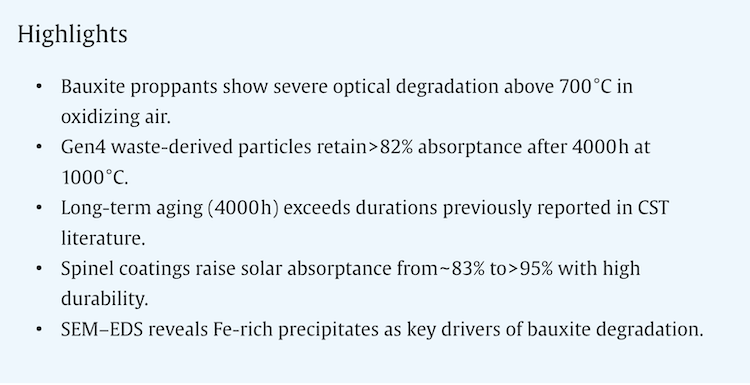
Concentrated solar thermal (CST) systems based on solid particle receivers demand granular materials that combine mechanical resilience, stable flow behaviour, and favourable thermophysical properties at high operating temperatures. Although optical performance has received extensive attention in the recent literature, the mechanical attrition kinetics, flowability characteristics, and thermophysical property evolution of waste-derived particles remain insufficiently characterized for engineering design of commercial receivers. This study examines the mechanical durability, particle flowability, and thermophysical behaviour of recycled waste-derived granulated particles (Gen2, Gen3, Gen4) and three spinel-coated variants (Cu-Mn-Fe, Cu-Mn-Co, Cu-Cr formulations), with sintered bauxite proppants serving as benchmark materials. Mechanical assessment included single-particle crush strength testing with Weibull statistical analysis on populations of 50 particles per material, repeated free-fall drop testing through 4 m vertical columns over 5000 cumulative drops, three-body abrasive wear testing under 30 N normal load, and continuous lift-circulation testing for 1000 h simulating skip-hoist transport conditions. Flow behaviour was quantified through angle of repose, Hausner ratio, Carr compressibility index, mass-flow rate through standardized orifices (5–25 mm diameter), and dynamic angle of repose using a rotating drum apparatus. Thermophysical properties were measured across 25–1000 °C using laser flash analysis for thermal diffusivity, differential scanning calorimetry for specific heat capacity, and transient hot-disk method for effective thermal conductivity of packed beds. Results indicate that Gen4 particles produce a characteristic Weibull crush strength of 134 N with a modulus of 7.8, exceeding the proppant benchmark (BL 17/32: 240 N, modulus 4.6) in distribution uniformity despite lower mean strength. After 5000 cumulative drops, Gen4 particles produced 1.8 wt% fines (less than 200 µm) compared with 8.3 wt% for SB 31/51 proppants, indicating roughly fivefold reduction in attrition fragmentation. Three-body abrasive wear tests measured Gen4 specific wear rates of 2.1 × 10⁻⁴ mm3/(N·m), about 35% lower than the proppant average. Flow assessment placed Gen4 particles in the free-flowing regime with a Hausner ratio of 1.14 and angle of repose of 28.4°, while spinel coatings produced negligible flowability degradation. Thermal diffusivity of Gen4 particles decreased from 0.79 mm2/s at 25 °C to 0.41 mm2/s at 1000 °C, with specific heat capacity increasing from 0.78 J/(g·K) to 1.34 J/(g·K) across the same range. Effective packed-bed thermal conductivity reached 0.62 W/(m·K) at 1000 °C, providing favourable heat-transfer performance for receiver applications. Multi-criteria assessment confirms that Gen4 particles and their spinel-coated variants meet the integrated mechanical and thermophysical requirements for commercial CST particle receivers while offering economic advantages over conventional proppants.
Zhaoyang Cai, Miao Wang, Yu Qiu, Development and durability assessment of recycled Waste-Derived particles for concentrated solar thermal applications, Solar Energy, Volume 314, 2026, 114630, ISSN 0038-092X, https://doi.org/10.1016/j.solener.2026.114630