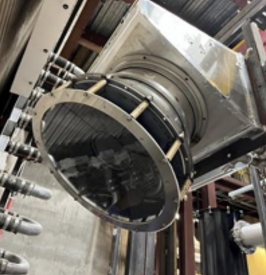

Researchers at GE Aerospace Research and Sandia National Laboratory have successfully fabricated and tested a 3D-printed silicon carbide (SiC) volumetric solar air receiver, achieving a temperature of 1390°C on-sun.
The goal of the three-year program, now completed, was a feasibility demonstration of materials, design, fabrication, and testing of a 50 kWth air receiver, with the potential to be scaled up for use in high temperature industrial processes. The research was designed to meet two primary goals: to develop a high-temperature receiver and test it on-sun, and use a design that would enable it to be scaled up.
“The other similar ceramic receiver technology that has been tested is that of DLR that can reach temperatures this high,” explained Kamala Raghavan, who led the work as the Technology Manager at the Integrated Energy Technologies Office.
This was newly created during a major reorganization of the U.S. Department of Energy (DOE) announced by the Trump administration in November 2025. There, she headed the team at the new Thermal Energy Systems program, which has replaced SETO, the Solar Energy Technologies Office.
Temperatures this high are essential for several solar thermochemistry applications, such as Synhelion’s synthetic aviation fuel production in Germany.
“Our objective was to advance receiver technology for operation at temperatures exceeding those achieved by the Gen3 supercritical carbon dioxide power cycle,” noted Raghavan.
“Consequently, the volumetric air receiver designs were developed for high-temperature industrial process heat applications, functioning at significantly higher temperatures compared to Gen3. Scientists at GE Aerospace Research have successfully incorporated silicon carbide ceramic matrix composite – CMC – material into the development of a modular volumetric air receiver, optimizing its performance at elevated temperatures. This innovation enables concentrating solar thermal technology to serve high-temperature industrial processes. Solar heat is attractive especially for processing plants that are in remote locations and demonstration of this receiver technology is a big leap forward.”
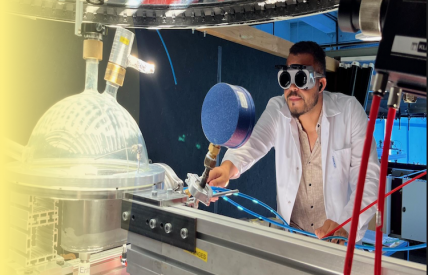
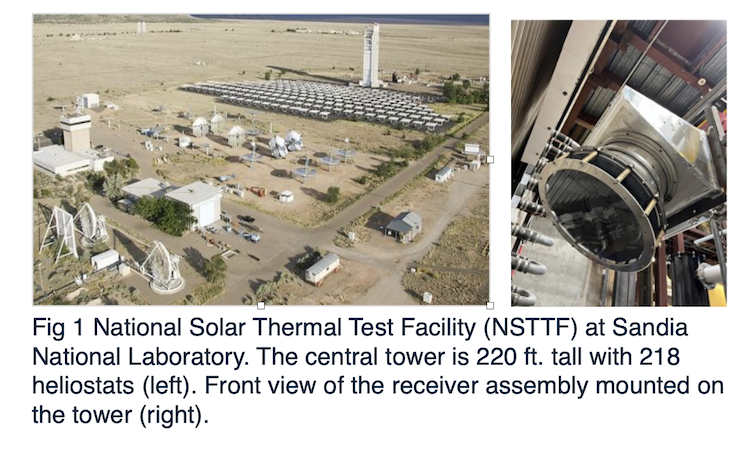
During the three-year program, the GE Aerospace Research team led by Dr. Reza Sarrafi-Nour, designed and built a 50 kWth receiver, which was then tested on-sun by a team of scientists led by Dr. Ken Armijo at the National Solar Thermal Test Facility (NSTTF) at Sandia National Laboratory.
Sandia designed and built the overall system with the receiver for the final testing. The design is highly modular to enable an easy scale-up.
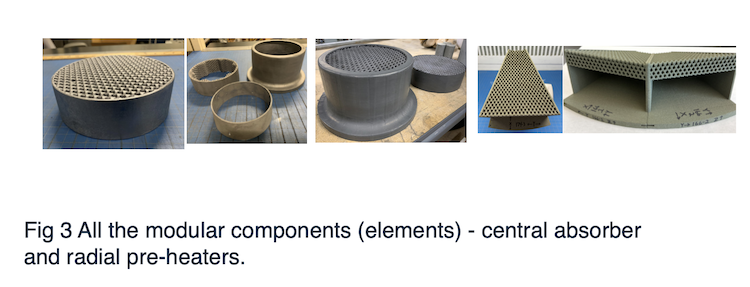
“All the ‘elements in the receiver – the pre-heater wedges, the central absorber unit, everything is assembled. It’s not a monolithic receiver, so that the design can be scaled up easily, and what we pushed for was having the design and fabrication technique which can help us achieve modularity, and scale-up,” she explained.
The fabrication process is binderjet additive manufacturing. For this 50 kWth test, the receiver was approximately 18 inches across. The small size of the receiver made focusing the heliostats crucial.
“The accuracy is in millirads, so it’s not very trivial to get the heliostats aimed at such a small region to achieve the required temperature without destroying the receiver,” Raghavan noted.
“This was among of the biggest challenges once we put this receiver on the tower — it is not trivial to focus the solar flux on the receiver. It took about two days of work by Sandia researchers to make sure we got the right flux profile on the receiver.”
GE Aerospace funding
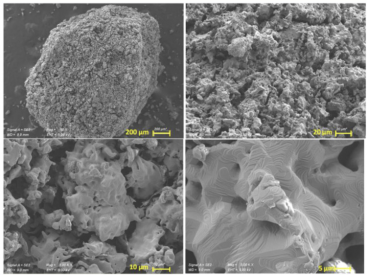
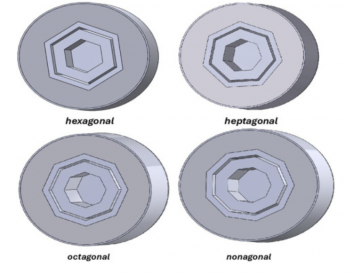
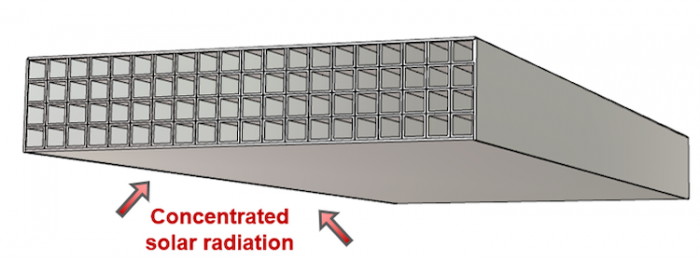
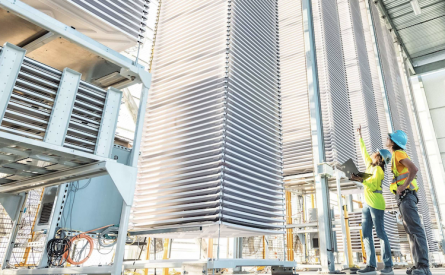
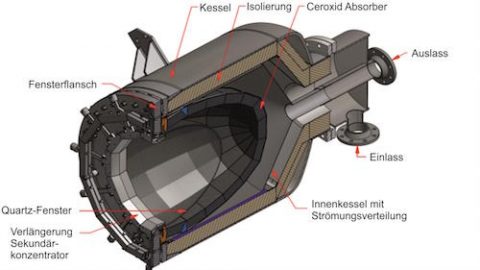
The SiC CMC material itself is developed out of research begun by GE Aerospace. This SiC CMC material technology is the same as that used in the GE aero engines. GE aerospace was funded to use this material and fabrication technology to develop critical lattice structures used in the receiver design, seen here in Fig 3.
 Several different lattice designs were tested at laboratory scale after which the GE team converged upon one which had structural stability, good thermal properties for final on-sun testing.
GE Aerospace brought their expertise in SiC CMC technology and has helped develop this high temperature receiver for appilcations in industrial processes.
Several different lattice designs were tested at laboratory scale after which the GE team converged upon one which had structural stability, good thermal properties for final on-sun testing.
GE Aerospace brought their expertise in SiC CMC technology and has helped develop this high temperature receiver for appilcations in industrial processes.
Originally in 2022, the industry partner was Heliogen, a US concentrated solar startup that went under, but DOE helped the team find a new partner for testing so that GE aerospace could continue the receiver development. It was important for DOE to continue the work because materials that can withstand these temperatures have already proven their performance in aerospace applications.
“The GE Aerospace Research team was interested in using silicon carbide materials for various other applications,” said Raghavan.
The three-year project was at Technology Readiness Level of three (TRL 3) out of 9 when they began in 2022. With all the testing they have done, including now on-sun at Sandia, they have moved the project to TRL 5. Raghavan said however, that no further work is currently planned for funding the scale-up efforts – for now.
“As a federal funding agency, we solicit proposals, and we funded this project with GE and Sandia,” she said.
“It’s for interested CSP and process industries to discuss with GE Aerospace and Sandia and take it further. Our office invests in R&D and feasibility demonstrations and accelerates technology towards commercialization.”
To gain interest from industry, the ceramic receiver technology would need to reach TRL 9, which means further scaling up and on-sun testing. Nevertheless, GE Aerospace and Sandia are pleased with the outcomes. The results validate the materials, design and performance tests of the receiver.
At the start of the project, the key question was whether a receiver using a modular lattice design of silicon carbide could perform reliably during several hours of on-sun testing. The researchers confirmed that it can.
More from SolarPACES on similar solar receiver research:
Optimizing the safety factor in high temperature solar absorbers
3D-Printed solar receiver of honeycomb mesh to spread heat evenly
3D-printed ceramics tested to maximize thermal energy storage in molten salts
3D-printed ceria is a game-changer to increase solar fuel efficiency