
Cargo shipping will be very different in 2050. Increasingly, the shipping industry is looking to decarbonize and green ammonia research is funded globally from China to the UK
Green ammonia could be made sustainably using solar thermochemistry instead of the way it is made today in the fossil-fueled Haber-Bosch process, which taps fossil energy for the thermochemistry and the heat and the high pressure it requires, while emitting almost three tons of CO2 for each ton of ammonia it produces.
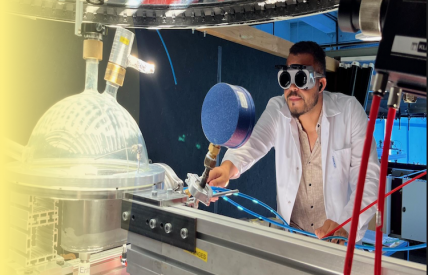
A research team from three US research institutions now has a patent pending for a novel process to make green ammonia using solar thermochemistry. (How solar fuels work: thermochemistry) The research is known as STAP (Solar Thermal Ammonia Production) and was funded by SETO; the US Department of Energy Solar Energies Technologies Office.
Dr. Andrea Ambrosini leads the researchers at Sandia National Laboratories in collaboration with Ellen Stechel, Co-Director, ASU LightWorks® at Arizona State University, and Peter Loutzenhiser, Associate Professor of Mechanical Engineering at Georgia Institute of Technology.
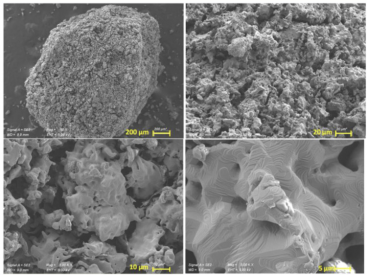
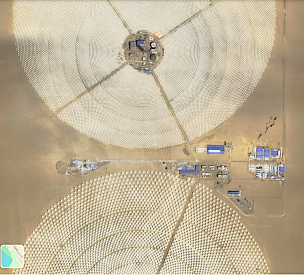
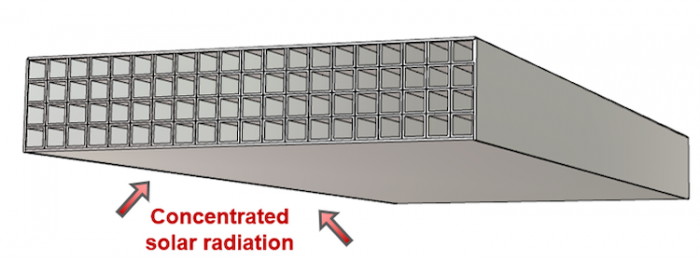
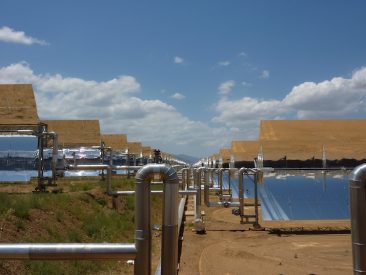
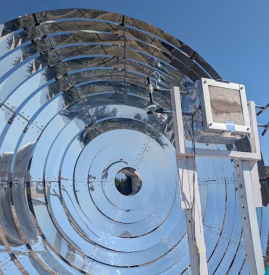
The team has developed a technology that can sustainably extract nitrogen from the air and source green hydrogen externally, and provide the heat needed to power the process from direct solar thermal energy instead of fossil fuels. Their results in early testing suggest that their process can potentially be more efficient than today’s fossil-fueled technology:
“The overall NH3 yield in this process, more than 50%, is 3-4 times higher than the established catalyzed Haber-Bosch process, without sacrificing the ability to operate at kinetically favored high temperatures, and with an order of magnitude less of pressure requirement,” noted one of their abstracts presented at the SolarPaces 2022 Conference; Solar Ammonia Production via Novel Two-step Thermochemical Looping of a Co3Mo3N:Co6Mo6N pair
Potential to decarbonize shipping
Green ammonia is an important area of solar thermochemistry research because the future market for green ammonia could be larger than fertilizer production. Agriculture and shipping are both next-generation targets for decarbonization.
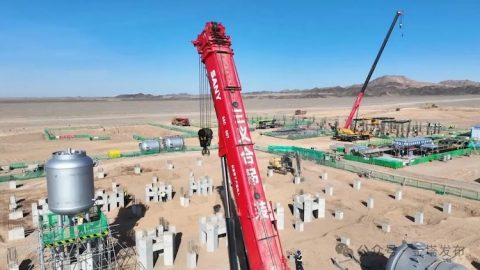
China has the world’s largest shipbuilding industry. In July, after his mission to sell the world’s largest shipping industry on green ammonia to decarbonize shipping, Aelius Energy CEO Xavier Lara signed an agreement for the first green ammonia pilot, converting a 4,000 metric ton ship engine in the Qingdao port. Aelius Energies secured the world’s first conversion of a heavy fuel two-stroke ship engine to run on green ammonia.

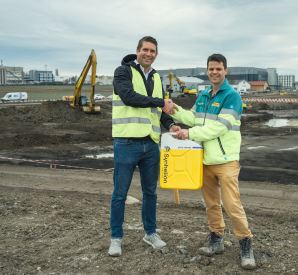
CEOs at AELIUS Energies and Shanghai Electric cement partnership on making green hydrogen for green ammonia to decarbonize shipping: June 2023
More reading:
Just Published at ACS: Synthesis and Structural Study of Substituted Ternary Nitrides for Ammonia Production
About STAP: Solar Thermal Ammonia Production (STAP)
SolarPACES conference paper: Solar-Thermal Ammonia Production: A Renewable, Carbon-Neutral Route to Ammonia via Concentrating Solar Thermochemistry
SolarPACES Conference presentation: Solar-Thermal Ammonia Production: A Renewable, Carbon-Neutral Route to Ammonia via Concentrating Solar Thermochemistry