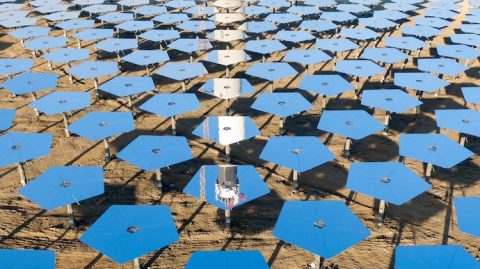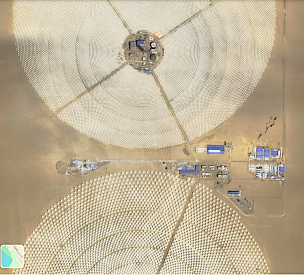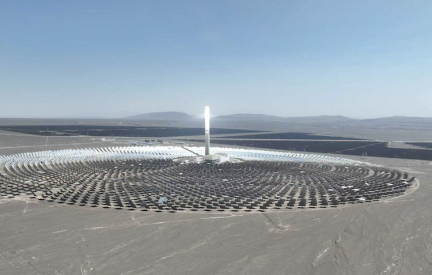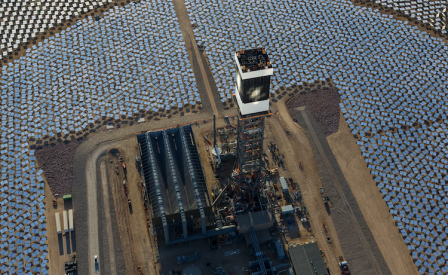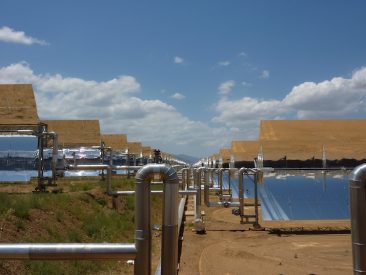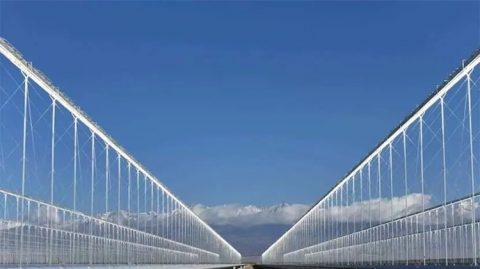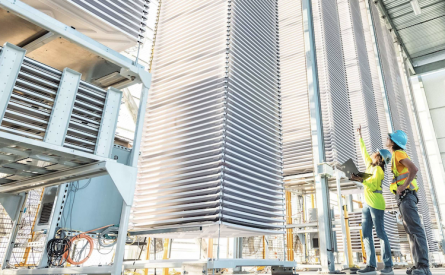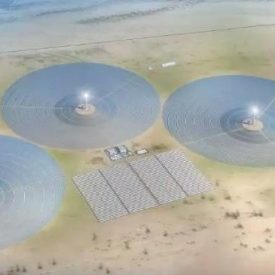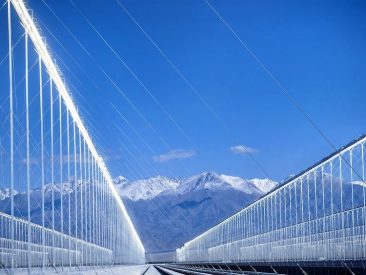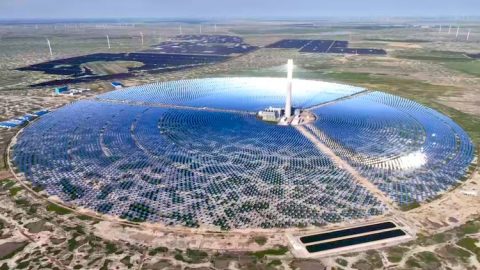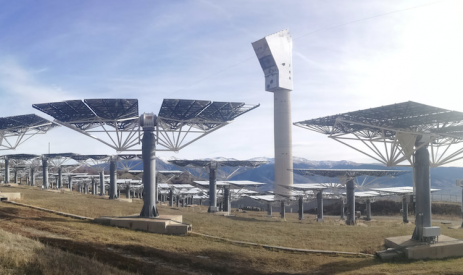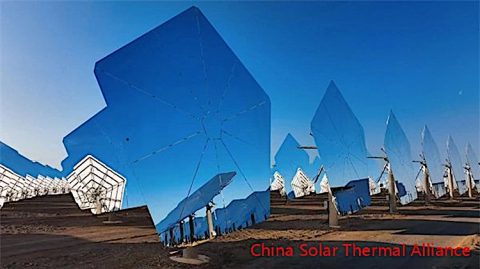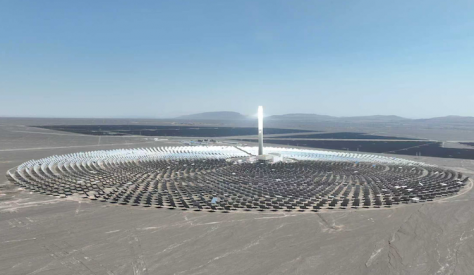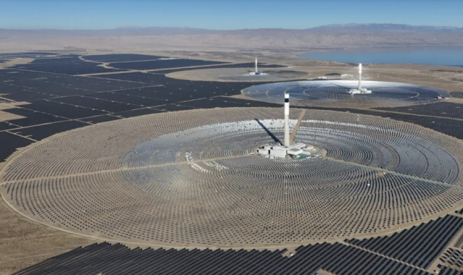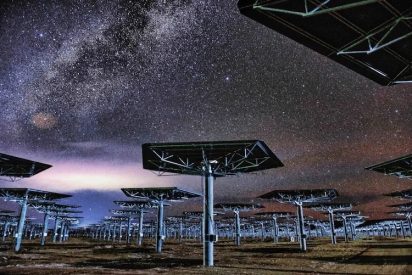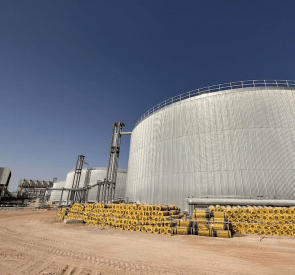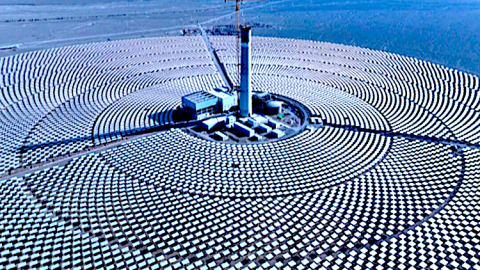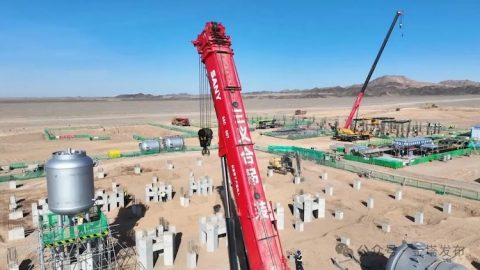

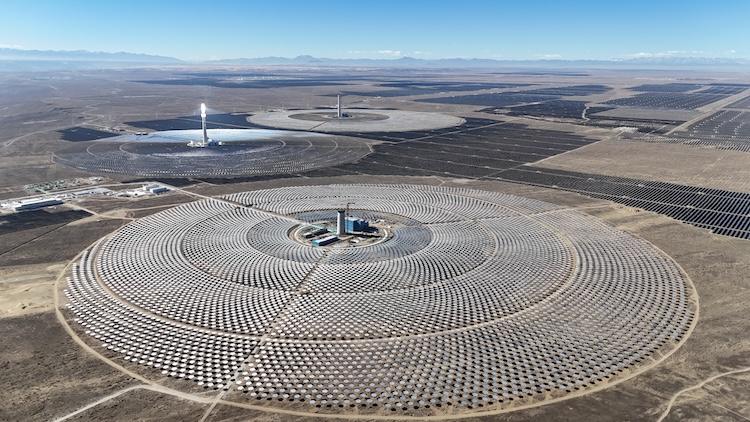
Stellio heliostats at Talatan New Energy Park in Qinghai IMAGE © DBC
Like most countries, China favors domestic suppliers for its renewable energy projects. As a result, virtually all companies supplying components for the country’s complex concentrated solar power plants are Chinese.
However, it is not impossible for a Western company to establish itself as a technology provider to China. The German company sbp sonne developed both parabolic trough and heliostat designs that are currently deployed under license in China.
Both of their technologies are used in CSP projects that have consistently achieved strong annual performance results. EuroTrough is a large parabolic trough design that enabled rapid installation at the Trough CSP project in Urat, Inner Mongolia, which repeatedly reports excellent annual performance. This Trough technology has since been deployed at the Zhabuye project in Tibet and is also planned for the Damxung project there.
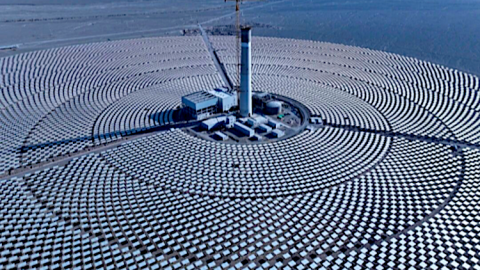
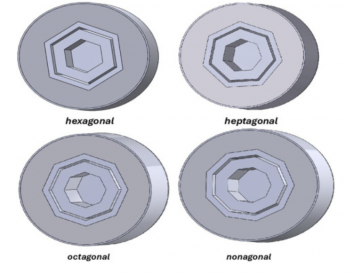
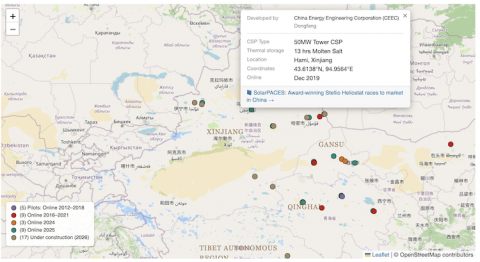
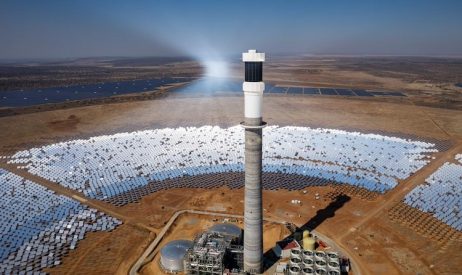
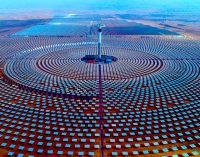
For Tower CSP, the Stellio is a unique ten-faceted heliostat, with all segments controlled from the center for superb efficiency and wind resistance in tower CSP projects. It was first deployed at the 50 MW Hami CSP project, where it also sets strong annual and overnight performance records. Both designs have received international recognition: EuroTrough won the SolarPACES Technology Innovation Award in 2010, followed by Stellio in 2015.

The Stellio heliostats from Dongfang Boiler at China’s Kumul CSP project IMAGE © DBC
From research to first-mover advantage
The Stellio heliostat was developed by sbp sonne together with its partners Ingemetal and Masermic, tested on-sun at the Plataforma Solar de Almería (PSA) in Spain and evaluated by the German Aerospace Center (DLR) in Germany, where it went from prototype to commercial deployment in China in an unprecedented 30 months.
How did German engineering gain a foothold in a much larger nation that has no shortage of its own excellent engineers?
“We were at the forefront of technology development, had an excellent track record in turning research results into technologies ready for implementation, and when China started to consider CSP technologies on an industrial scale, we were probably the most advanced technology provider at that time. Therefore, we were chosen for both projects,” explained Alf Oschatz, Managing Director of sbp sonne.
The collaboration between sbp sonne and China effectively began in Spain. At PSA, researchers from sbp sonne and DLR were testing a Stellio prototype when visiting representatives from China expressed strong interest in its high efficiency and wind performance.
How sbp sonne partnered in China
Deploying a foreign-designed heliostat deployed at scale in China requires a strong local partnership. According to Oschatz, the key to the company’s success was finding a partner in Dongfang Boiler that was committed to collaboration, recognised the respective strength of both parties and was willing to invest in further improvements.
“We found with Dongfang that they invested in learning and, by delivering projects, improving elements of the Stellio technology,” said Oschatz.
“I think the recipe for success is finding a partner who’s interested in becoming familiar with the technology but also willing to invest in learning and improving the overall setup in order to become competitive compared to other market players.”
Dongfang Boiler is one of China’s major state-owned equipment manufacturers. It has established intelligent, semi-automated manufacturing lines in Tibet and Xinjiang for Stellio developed by sbp sonne, and engineered it for harsh high-elevation climates and wind resistance.
Navigating control systems IP
For its heliostat controls outside China, sbp sonne partners with Masermic. Their system is not open source, as it contains IP and proprietary algorithms that technology providers do not want to disclose. However, China required its own electronics control hard- and software, favoring a more generic, open-source setup.
“There are certain political aspects that play a role,” Oschatz explained. “China defined certain things as critical infrastructure and requested an open-source setup for the control system, similar to what happens elsewhere in the world. So, the control system currently used for Stellio is, in our opinion, probably less optimal but more transparent.”
Despite that compromise on software, Oschatz says the company’s underlying intellectual property has been respected throughout its activities in China, both for EuroTrough and Stellio.
“We didn’t have any trouble getting our IP respected and protected, both for Stellio and for EuroTrough,” he said. “Our experience with Chinese partners has been positive for both technologies.”
Learning curve
At the SolarPACES Conference in Spain 2025, Axel Schweitzer of sbp sonne noted that repetition drives falling costs.
“If you produce something, you always learn by producing more and higher numbers,” Oschatz explained. “You become more familiar with the technology. You can look at the manufacturing and assembly methods and improve them here and there a little bit. And even if the improvements seem to be small, if you have a project which has approximately 10,000 or 15,000 heliostats, then each and every improvement pays off in the end. Stellio has been deployed successfully at four projects already, the fifth has started recently and we see a substantial decrease in cost.”
From the first production run for the initial Stellio deployment at the 50 MW Tower CSP plant in Hami, Thomas Keck, technology developer at sbp sonne, noted that even the first production line exceeded the optical accuracy of the sample.
“From the numbers that we saw from DLR, we expected Stellio to have better than industry standard optical efficiency. But in production, these are even beyond our targets in the optical quality,” he told SolarPACES in 2019.
Cost is king in China
Not every dynamic in the Chinese market favors sbp sonne’s engineering-first approach. Oschatz described tender specifications that price heliostats purely by mirror area, disregarding performance gains a more efficient design can deliver.
“Sometimes the tender only requests a certain mirror area—they ask, give me a price for 500,000 square meters of mirror area, regardless, without asking about performance criteria at all,” he said. “That’s strange. So the advantages of higher performance are not always acknowledged appropriately.”
But Oschatz is appreciative of the more general coherence of policy logic behind China’s broader CSP support, which has shifted from heavy subsidy toward market competition as the technology has matured.
“Overall, the commitment of the country to improve and to get CSP going is definitely there,” he said.
“The first round of projects was subsidized and supported by the government. Now CSP must compete with other technologies on the market, and overall, I think it’s been a kind of well-structured approach for supporting new technology and implementing it on a country level.”